Ask Jamey
Jamey Aebersold has generously agreed to answer a limited number of questions. To submit a question, just email andrew(at)jazzeveryone.com and we will forward it to Jamey. Then look for your question below.
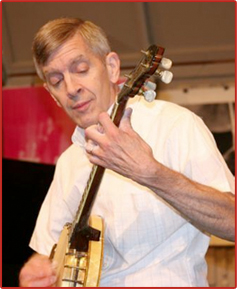
Jamey can do it all!
Question:
Hello, Sir!
What advice is there when ONE encounters.."The Wall?"
I feel as if all I have been doing has been the same. I have to admit that the exercises that I have been working on are getting under my fingers, but I guess I am being a bit too forceful on myself to "perfect" it. I want to move and FEEL/NOTICE the progressiveNESS.
What helps you stay motivated in music?
I feel as if I lose it SOMETIMES....I want to get better at feeling better as well...
With Regards,
Ricky Ray
Hernandez
Answer:
Dear Ricky,
Hang in there and don't give up. "Infinite boiling softens the stone." I think that is an African saying and I've always liked it because it's true.
To feel better is to control your mind. It's your mind that makes you FEEL like you don't feel good. So, you have to change you’re thinking about yourself. Playing jazz is not a competition. If there is any competition, it has to do with "competing with that part of yourself that tends to be lazy."
You ask what helps me stay motivated in music. I get a whole lot of enjoyment from listening to others play jazz. You just never know what's coming next and it's the surprises here and there that are so much fun. And, then I use their inspiration to carry my own playing and practicing. Once you get some basics under control it becomes a lot more fun because your fingers do a much better job of following the music in your mind. The guess work goes out the window so to speak and you 'Make Music.'
Incidentally, I listen to a lot of jazz. All the time in my van and at home while working. I've got a huge record collection and I truly enjoy listening. The recordings have been my constant teacher throughout my almost 72 years of listening and playing music.
I LOVE JAZZ. It gives me freedom.
Listen, practice, listen, practice, listen, practice.
Jamey
Question:
Hi Jamey. I'm fascinated by those jazz voicings and the comping of the piano on your play-alongs. Is there a book on the adaption of such pianistic jazz voicings and comping for the guitar? Cheers, Torq
Answer:
Torq,
Yes, we do have a book with guitar comping that goes along with my Volume 54 “Maiden Voyage” play-a-long CD. It has guitar comping with bass and drums on one channel and the bass and drums on the other channel. The guitar comping has been transcribed and is in the book so you can SEE what is being played. It’s by Mike Di Liddo from Miami, Florida. You can find it on our website
www.jazzbooks.com and the ordering code letters are: MVG. $17.95 U.S. price.
Jamey
Question:
Jamey,
I'm sitting here with Uncle Willie and his son in law Oliver and we have a question. Who is the rhythm section on your Hot House play along CD?
Best Wishes for a Happy New Year!
Steve
Answer:
You asked who the rhythm section is on my Volume 94 “Hot House” play-a-long CD. Well, it’s some of the finest musicians and the recording circumstances were very different on that one.
Pianist James Williams and I first met years ago in Decatur, Ill. at a big band camp. James was from Memphis, a student at the time and I was teaching there at the National Stage Band camp. We became friends and later worked and taught together. Way back in 2000 James called and said he was bringing a trio to Louisville, KY which is next to my town of New Albany, Ind. to play a concert for the Louisville Jazz Society. On his tour of several cities he would be bringing Ron Carter on bass and Billy Higgins on drums. I said, “why don’t we do a play-a-long recording while you’re here?” He agree and we set it up. By the time the day arrived, Billy Higgins had gotten sick and Ron Carter couldn’t make the trip so James used Christian McBride on bass and Jeff “Tain” Watts on drums. The day before, they played down in Arkansas and had an awful time getting a flight to Louisvlle.
They finally arrived and had had no sleep to speak of. They played the evening concert for the Lou. Jazz Society and the place was packed. The concert was over around 11pm and we headed for my house (basement) to do the play-a-long recording. They did each track in one take and as you can hear, the music was fantastic. We finished up a little after 2am. Jeff had a 6am flight to L.A. and Christian headed back to New York while James flew to St. Louis to play another job there. James died four years later. He made several play-a-longs for me and I will always cherish his friendship and musicianship.
Jamey
Question:
Jamey:
I've used your materials for many, many years, and I've had a question I've wanted to ask for a long time—this seems like the perfect opportunity. You consistently superimpose the Dorian mode over all minor 7th chords regardless of their function. I understand superimposing Dorian over the IImi7 chord in a major II/V7/I progression. However, I don’t understand superimposing Dorian over the Imi7 chord in a minor II/V7/I progression. Why not Aeolian? Can you explain your theoretical approach to this? Thanks a ton!
David
Answer:
David,
Aeolian puts a Ab in there and doesn’t fit the sound. When you get to the one chord in minor, my choices, and the ones I hear others playing seems to be either C dorian OR, C melodic minor, ascending. This amounts to a C major scale with a lowered third, Eb. Aeolian is not used very often as a minor choice because of the Ab. Some people will THINK C Aeolian over the D half-dim chord because it has the same notes as D half-dim: C D Eb F G Ab Bb C. But when you get to the G7(alt) you need to change a couple notes and then change again when you get to the final chord, C-. Playing through minor 2-5-1’s has gotten more sophisticated in the past 50 years due to musicians thinking more scalar than just chords (arpeggios). Another thing to keep in mind is, what chord is the piano or guitar player playing when they get to the C-. The soloist usually tries to match the harmony, IF their ears can HEAR the exact chord choice being played. Ah, the quest for better ears for which to HEAR.
Jamey
Question:
Jamey,
Have you ever considered adding a "Fermata Practice Track" to your wonderful play-along recordings? For example, a track with each individual chord of a tune is repeated numerous times before moving on to the next chord. The track could have the entire rhythm section playing or even say, an organ sustaining each chord. The improviser would then have to negotiate each and every chord of the tune and it would go a long way in helping him/her to better learn the melody and chords of a particular tune. I started using Band in the Box in this way and then when I play with your recordings I can hear and play more easily.
Thanks,
Ray, 12/12/10
Answer:
Ray,
That would be like having a private piano player to play and sustain each chord while you run up and down and around each scale/chord. Then, you nod your head the piano player moves on to the next chord. Eventually, covering every chord in the tune. Yes, it’s a great idea and I do have it on one play-a-long set-Vol.47 “I Got Rhythm Changes”. That set does this in the key of Bb, but not all twelve keys. This is where parents with keyboard facility could come in real handy while their jazz children are growing up. Run through a little of this before the kid goes to school each moring and look out!
Jamey
Question:
What is the best way to develop a unique sound and style in jazz ?
How do I obtain a more interactive approach to playing with the rhythm section using your play along series?
What are the major pitfalls of an intermediate to advanced improviser?
Thanks, Daniel 12/6/10
Answer:
Daniel,
You ask about how to develop a unique sound and style in jazz. The first thing is to listen to jazz recordings. Jazz has been around for 100 years and thousands of players have developed their own sound. You can often recognize a person just by their playing several notes because their SOUND hits your ears and your memory says “that’s so and so.” Having a good instrument and a good teacher can help point you in the right direction. Your sound will grow as you grow. For instance, sax players often try various mouthpieces before they settle on one that seems to give them the Sound they are looking for.
My play-a-longs are not interactive, as you know. But they lay the foundation for melody, harmony, rhythm and time keeping. The musicians on my recordings are top notch and have years of experience playing behind numerous soloists. When they record the educational CDs for me, they try to keep in mind a person soloing along with them, and thus often will build the track from start to finish. If you are a rhythm section player, my Volume 114 “Good Time” has 4 CDs/book with different combinations of piano, bass and drums on each CD. It has helped many up and coming musicians.
You ask what are major pitfalls: I would say giving up before you reach your goals. Playing jazz is a life-long journey and doesn’t really end until you do. Jazz involves using ones imagination and thus you learn to be creative with notes, rhythms, phrasing, etc. and you learn a lot about life itself along the way. Thelonious Monk once said Jazz meant “Freedom.” I think that really sums up what jazz is all about. But obtaining that musical freedom requires much discipline and practice along the way and that’s the journey. Don’t be too hard on yourself when you don’t reach every goal as soon as you would like. Patience has its own reward. Also, Never Give Up.
Jamey Aebersold
Question:
Jamey, any plans for a 2nd Tom Harrell play-along? Such an awesome composer (and of course, player!)
Thanks,
Bruce, 12/2/10
Answer:
I don't have anything by Tom Harrell planned. I agree, he's a marvelous composer and player. He taught at my Summer Jazz Workshops several years.
Jamey Aebersold
Question:
Jamey,
How did you become so proficient on all of those instruments? What was your first instrument, which is your favorite and do you play any brass instruments? Wow, that's a lot of questions!
thanks,
Willie, 11/26/10
Answer:
Willie,
I started out on piano at age five and was fired by my teacher at age ten. She said “you’ll never be a musician. You don’t want to practice.” So, I made the natural switch to my Dad’s Tenor Banjo. I took lessons on it and played duets with my Dad. I made my first money, two dollars, playing a local talent show. I think I came in last. At age 12, I started messing around with my older brothers alto sax and finally joined the school band in the sixth grade on alto but found it very boring. I played alto all through school, skipping band my sophomore year because I didn’t like marching and thought band was pretty dull. I rejoined my junior year and ended up being a thorn in my band directors side. I kept adding notes to the arrangements and he didn’t care for it. When I finally decided on going to college someone said I needed to play clarinet so I bought one and took lessons on it. I never did get very good on it because I didn’t spend the time practicing that it takes to become proficient. When I finally got to college, Indiana University in Bloomington, Indiana they said they didn’t have a sax teacher but I could take a Woodwind degree which meant I took lessons on Oboe, Bassoon, Flute, Clarinet and they let me take sax lessons from the Clarinet teacher. Needless to say, my heart wasn’t into Oboe and Bassoon but I did like trying to play the flute because at that time, the late fifties, there were several jazz musicians playing flute. While teaching private lessons in Seymour, Indiana on Saturdays, I bought a bass that stood in my studio and taught myself how to play it. I ended up playing many bass jobs over the next 25 or so years. I love playing bass and presently own two. Along the way I took up Tenor and Soprano sax. I also have a nice Gibson guitar and can play chords on the top four strings. I bought a trumpet years ago and tried playing it but quickly gave up.
I do most of my composing of songs in my mind and on the piano. I love writing songs. I love harmony, theory, jazz, my family and life in general. I’ve been very fortunate to have been involved for my entire 71 years in music and jazz. I like to use my imagination and I enjoy showing others how to be creative with music.
Jamey Aebersold
Question:
Hi Jamey,
Could you explain the process that you went through that led you to be able to play whatever comes to your mind on your horn? I'm good with my intervals, and I can generally place simple melodies to scale degrees, but I still don't feel like I have the total freedom of being able to get what's in my head out of my horn.
Answer:
Randy,
Well, I’m 71 now and about 20 years ago, around the age of 50, things seemed to get easier for me to do what you’re referring to – play exactly what you hear in your mind. It’s gotten better the past 20 years, too. I think I was busy doing many things and not setting down and practicing scales, chords, patterns, licks, changes to tunes, melodies to tunes, etc., etc. I listened a LOT, all the time when I wasn’t practicing or actually playing a job. I did and do hear music in my mind all the time and learned how to visualize the fingerings on my sax, piano or bass if I so chose to. I’m still thinking music and theory and harmony all the time. I don’t know how old you are, how long you’ve been playing, how much listening you’ve done, do you study privately with a good jazz teacher, have you played in combos with a teacher, how many tunes do you know from memory both the melodies AND the changes, do you play professionally for money and much more. Have you worked on ear training, while not practicing…like when in the car, walking, showering, etc. free mental time? Do you have one of my free Jazz Handbooks and if so, have you studied it carefully? Charlie Parker practiced 11 to 15 hours a day for 3 to 4 years. I’m sure that’s how he became proficient on the sax. Unfortunately, he didn’t take good care of his body so it collapsed at age 34. All that practicing gone to waste. “If you don’t take care of your body, where are you going to live?”
Feel free to write anytime.
Peace,
Jamey
Question:
Hi Jamey,
I have learned the most valuable things in my life for myself. I love music and I want to play jazz in a good way. In your opinion, can I develop the necessary skills to play jazz for myself? Although I play Alto Saxophone, I listen a lot of recordings from different indstruments and groups.
Thanks!
Miguel
Answer:
Miguel,
Listening is the most important part of learning to play jazz. I’m glad to hear you listen to a lot of different players and various instruments. That’s very important because articulation and phrasing can vary from instrument to instrument.
It’s important to learn the basic scales and chords and learn some patterns and licks that work over II/V7 and II/V7/I. If you have my Volume 3 play-a-long you’ll find a lot of very important musical ideas that can help your EARS to get the feel of jazz harmony. Once you begin to HEAR what others are playing you can mentally figure out the theory that goes on throughout their musical melodies. Volume 3 can be a be help in this regard.
Feel free to email Willie any time. I hope this information is helpful to you. LISTEN, LISTEN, LISTEN.
Jamey Aebersold